


Our Commitment to Preferred Polyester
Polyester is a fundamental fiber in our collections and one of the most used in the world: strong, durable, and wrinkle-resistant, it allows us to create lightweight hats that dry quickly. Additionally, unlike cotton, it does not fade or lose quality when exposed to the sun, which increases its durability. However, its production has a significant environmental cost: virgin polyester is a synthetic fiber derived from petroleum that requires a lot of energy to produce¹.
For this reason, over the years we have sought alternative solutions that would allow us to reduce dependence on fossil raw materials and increasingly move towards environmentally friendly materials (so-called preferred).
Among these is certainly recycled polyester (or rPET), a type of synthetic fiber that can be obtained through raw materials such as post-consumer PET plastic bottles, polyester fabrics and clothing, pre-consumer industrial waste, PET plastic packaging, and even fishing nets and plastic materials recovered from the oceans. These materials are then processed through mechanical or chemical processes to be transformed into new polyester products.
Each type of recycled polyester has its advantages and disadvantages, both in terms of production impact and fiber performance, and at Atlantis, we evaluate collection by collection which could be the best solutions.
Over the years we have experimented and will continue to experiment, but we have also chosen to set ourselves a precise goal: by 2025, at least 45% of the polyester we purchase to make our garments will be recycled. This is a commitment we share with all the companies that have chosen to join the 2025 Recycled Polyester Challenge, an initiative promoted by Textile Exchange to significantly reduce the entry of new fossil-based synthetic fibers into the fashion system².
Recycled Polyester from Bottles
To date, the most widespread type of recycled polyester³ is the one obtained through the recycling of PET bottles.
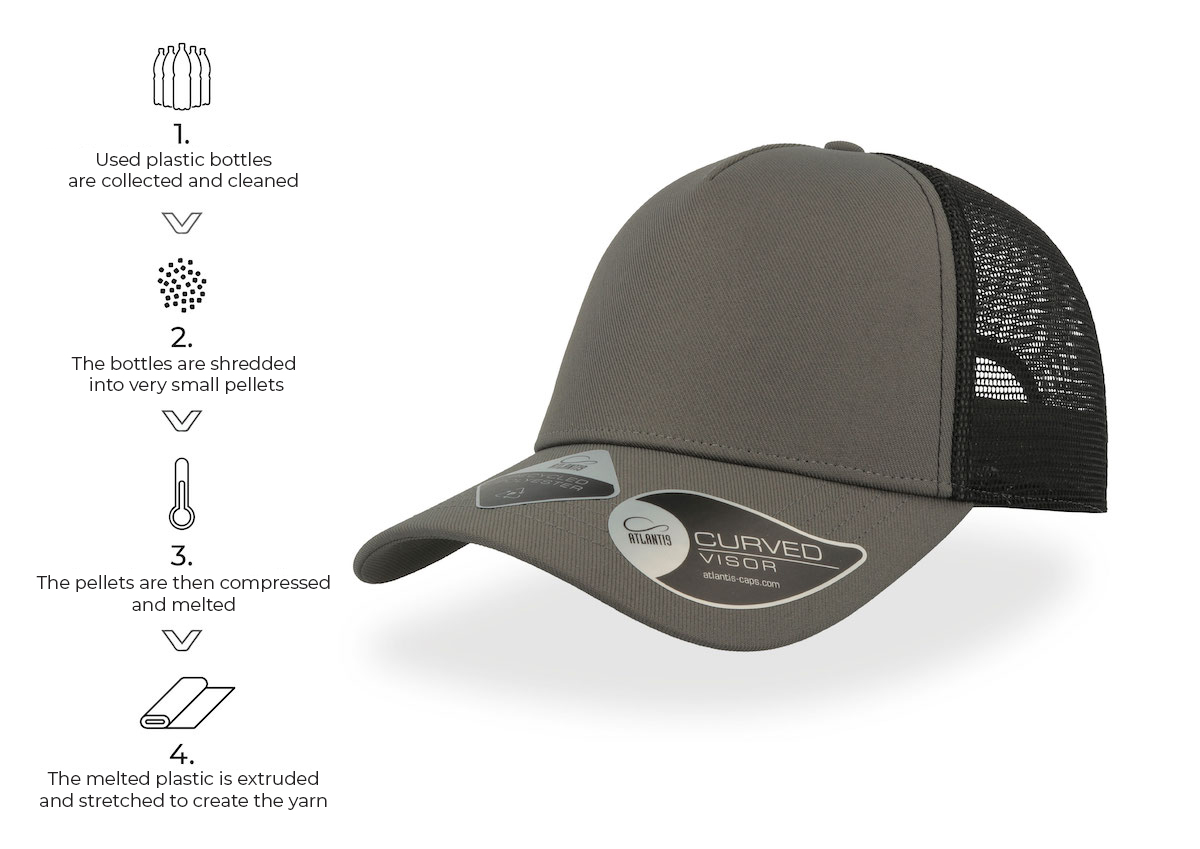
The method to create this type of fiber is mechanical: plastic bottles are collected, washed, and reduced into small fragments that are then converted into polyester granules to be transformed into textile fibers. It is an abrasive process that requires a limited use of water and energy⁴ and brings environmental benefits compared to the production of virgin polyester.
Our LCA⁵ study conducted on polyester products has shown, for example, that by replacing virgin polyester with recycled polyester, we reduce CO₂e emissions by 4%, and if we replace acrylic, we achieve a reduction of almost 70%.
However, recycled polyester obtained through the recycling of plastic bottles has objective limits both in terms of performance and environmental impact. The quality of the fibers obtained is indeed lower than that of fibers produced from virgin polyester or textile fiber recycling⁶. Additionally, mechanical recycling releases microplastics in quantities similar to that of virgin plastic. Using plastic bottles is also a choice that does not favor circular economy processes in the textile sector, as it does not allow for the direct recycling of fibers to create new fibers, but is limited to transforming a single-use plastic product into a textile material.